

Eventos
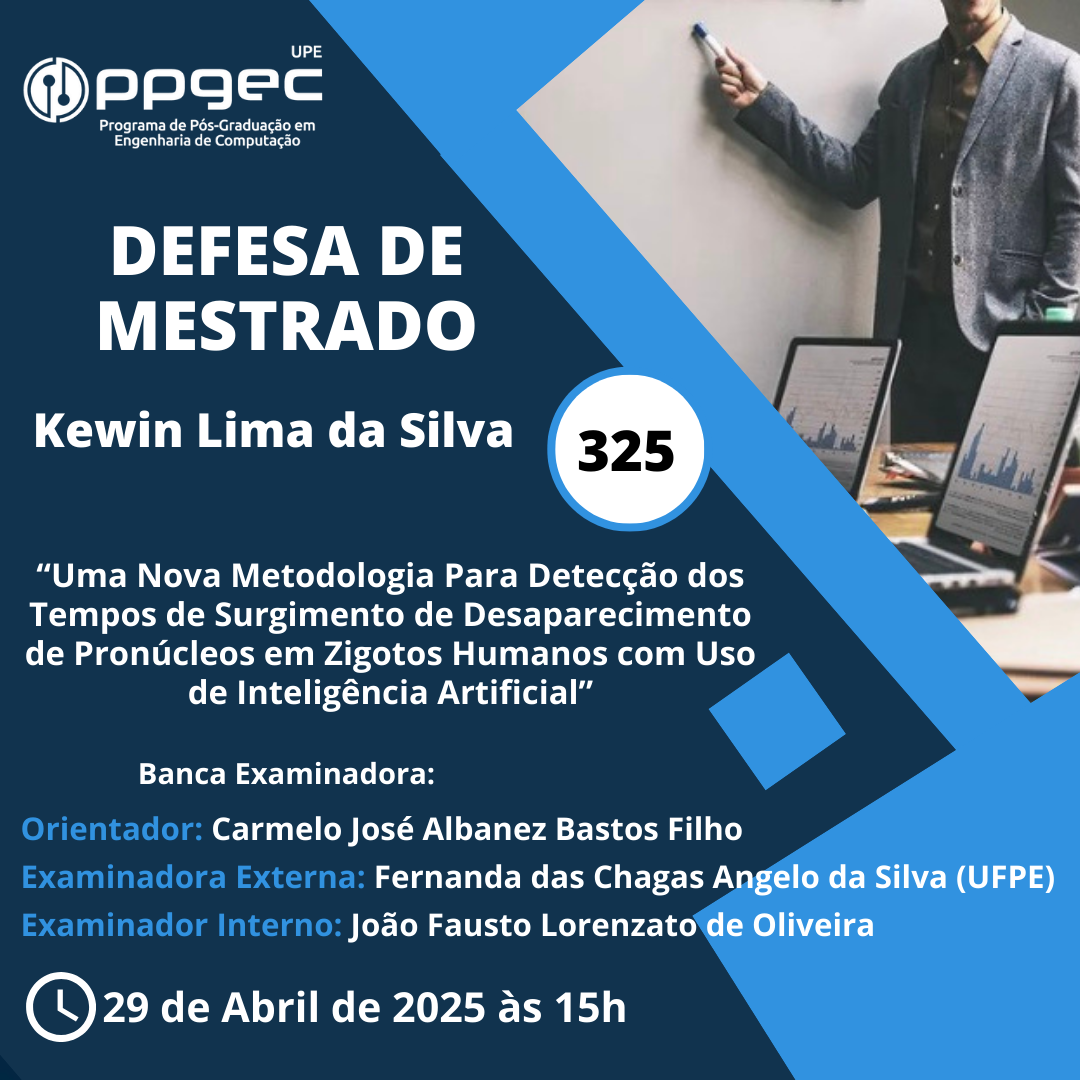
DEFESA DE DISSERTAÇÃO DE MESTRADO Nº 325
Aluno: Kewin Lima da Silva
Título: "Uma Nova Metodologia Para Detecção dos Tempos de Surgimento de Desaparecimento de Pronúcleos em Zigotos Humanos com Uso de Inteligência Artificial"
Orientador: Carmelo José Albanez Bastos Filho
Examinadora Externa: Fernanda das Chagas Angelo da Silva (UFPE)
Examinador Interno: João Fausto Lorenzato de Oliveira
Data-hora: 29 de Abril de 2025 às 15h
Local: Formato Remoto - Google meet
Resumo:
" A Fertilização In Vitro (FIV) representa um avanço significativo na medicina reprodutiva, mas ainda enfrenta desafios relacionados à precisão na seleção embrionária. Dentre os critérios considerados na avaliação de qualidade dos embriões, a determinação dos tempos de surgimento (tPNa) e desaparecimento (tPNf) dos pronúcleos no zigoto constitui um fator crítico, conforme estabelecido pelo Consenso de Istambul. Contudo, a identificação manual desses eventos em sequências de imagens time-lapse é uma tarefa exaustiva e suscetível a subjetividades, o que limita a padronização e a reprodutibilidade dos resultados. Frente a esse cenário, propõe-se uma metodologia automatizada, baseada em inteligência artificial, para a detecção precisa dos eventos tPNa e tPNf, contribuindo para a redução da variabilidade interobservadora e para o aprimoramento dos índices de sucesso da FIV. A proposta é estruturada em um pipeline composto por três etapas principais: (i) identificação e isolamento dos zigotos, (ii) segmentação dos pronúcleos e (iii) estimação temporal dos eventos. Inicialmente, imagens com resolução de 500×500 pixels, provenientes de 704 embriões acompanhados entre 2 e 6 dias de desenvolvimento, são processadas por um classificador construído sobre a arquitetura YOLOv11, que alcança 99% de precisão na localização dos zigotos. Em seguida, a fusão dos três planos focais centrais, onde os pronúcleos se manifestam com maior clareza, resulta em imagens RGB com menor ruído e maior compatibilidade com redes neurais modernas. O detector, também baseado em YOLOv11, segmenta os pronúcleos mesmo em casos de sobreposição, obtendo 88% de precisão, 86% de revocação e mAP50% de 88%. Por fim, um modelo de regressão implementado com Multi-Layer Perceptron (MLP) utiliza as confiabilidades das detecções para estimar com alta acurácia os tempos tPNa e tPNf, alcançando MSE de 0,0019 e RMSE de 0,0438. A metodologia é validada por meio de testes estatísticos robustos. A correlação de Pearson demonstrou forte alinhamento entre as predições da IA e as anotações humanas (r = 0,725 para tPNa e r = 0,978 para tPNf, ambos com p < 0,001), enquanto o teste de Wilcoxon indicou ausência de diferenças estatisticamente significativas entre os grupos. Adicionalmente, uma representação gráfica individual por embrião facilita a interpretação dos resultados, com destaque visual para os tempos estimados e níveis de confiança. O dataset utilizado, bem como os modelos e parâmetros, são publicamente disponibilizados, garantindoa reprodutibilidade do estudo. Conclui-se que a solução proposta apresenta desempenho comparável ao de especialistas humanos, com potencial para se tornar uma ferramenta assistiva na prática clínica da FIV, oferecendo transparência, robustez e acessibilidade à análise embrionária automatizada. "
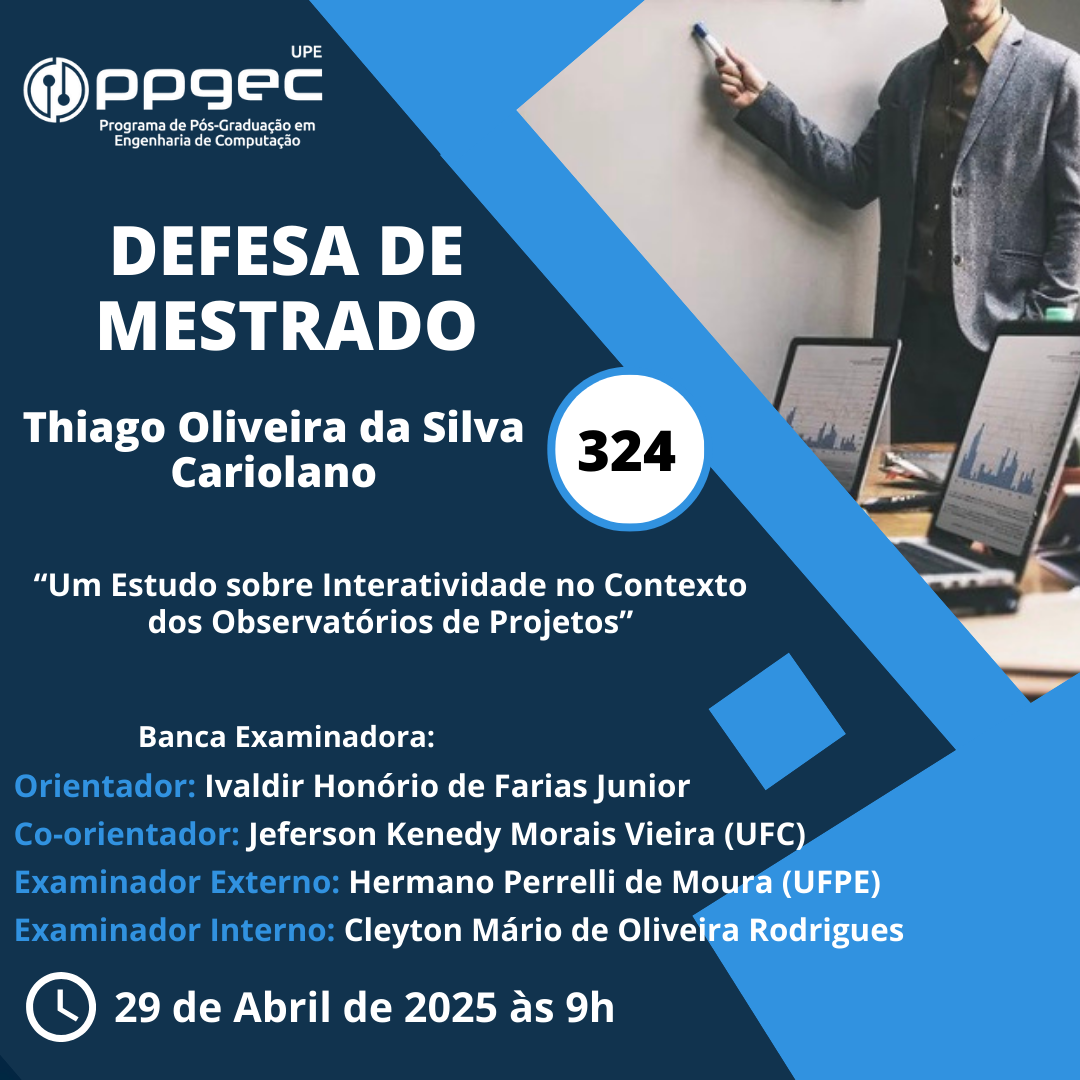
DEFESA DE DISSERTAÇÃO DE MESTRADO Nº 324
Aluno: Thiago Oliveira da Silva Cariolano
Título: "Um Estudo sobre Interatividade no Contexto dos Observatórios de Projetos"
Orientador: Ivaldir Honório de Farias Junior
Coorientador: Jeferson Kenedy Morais Vieira (UFC)
Examinador Externo: Hermano Perrelli de Moura (UFPE)
Examinador Interno: Cleyton Mário de Oliveira Rodrigues
Data-hora: 29 de abril de 2025 às 9h
Local: Formato Presencial - Sala CSEC
Resumo:
" Os observatórios de projetos são sistemas de informação que promovem a transparência em áreas específicas por meio da coleta, processamento e compartilhamento de dados. Para estruturar esses sistemas, o Modelo para Observatórios de Projetos (MPO) tem sido continuamente utilizado e aprimorado. No entanto, apesar dos avanços, ainda existe uma lacuna significativa na literatura sobre como integrar interatividade nesses observatórios, limitando a participação ativa dos usuários e o aproveitamento pleno dos dados disponibilizados. Diante desse desafio, esta pesquisa teve como objetivo investigar como os mecanismos de interatividade promovem a comunicação bidirecional e o engajamento entre os usuários e um sistema, especificamente no contexto de observatórios de projetos. Para isso, o estudo foi conduzido em cinco etapas principais: (1) Revisão Ad-Hoc da Literatura, para identificar os conceitos estruturantes da pesquisa; (2) Desenvolvimento de Projetos Piloto, com experimentação inicial da implementação de observatórios de projetos; (3) Revisão da Literatura Cinza, para embasar a proposta de implementação com estudos relevantes da literatura disponível; (4) Estudo Aplicado – Evolução do Observatório de Projetos, no qual os mecanismos identificados foram implementados; e (5) Avaliação do Observatório de Projetos quanto aos Mecanismos de Interatividade, por meio de entrevistas com usuários. Na revisão da literatura cinza, foram analisados 9.640 documentos, dos quais apenas 1,14% atenderam aos critérios de inclusão previamente estabelecidos. Como resultado, foram identificados 22 padrões de classificação de mecanismos de interatividade, dos quais 12 foram implementados no observatório estudado. A avaliação com usuários demonstrou que esses mecanismos contribuíram para uma experiência mais dinâmica e interativa, reforçando a importância da interatividade na transparência e no acesso às informações. A pesquisa contribui significativamente para a área ao oferecer diretrizes claras para a implementação de interatividade em observatórios de projetos, além de apresentar insights práticos, desafios e lições aprendidas, que podem orientar futuras iniciativas na construção de sistemas mais interativos e eficazes. "
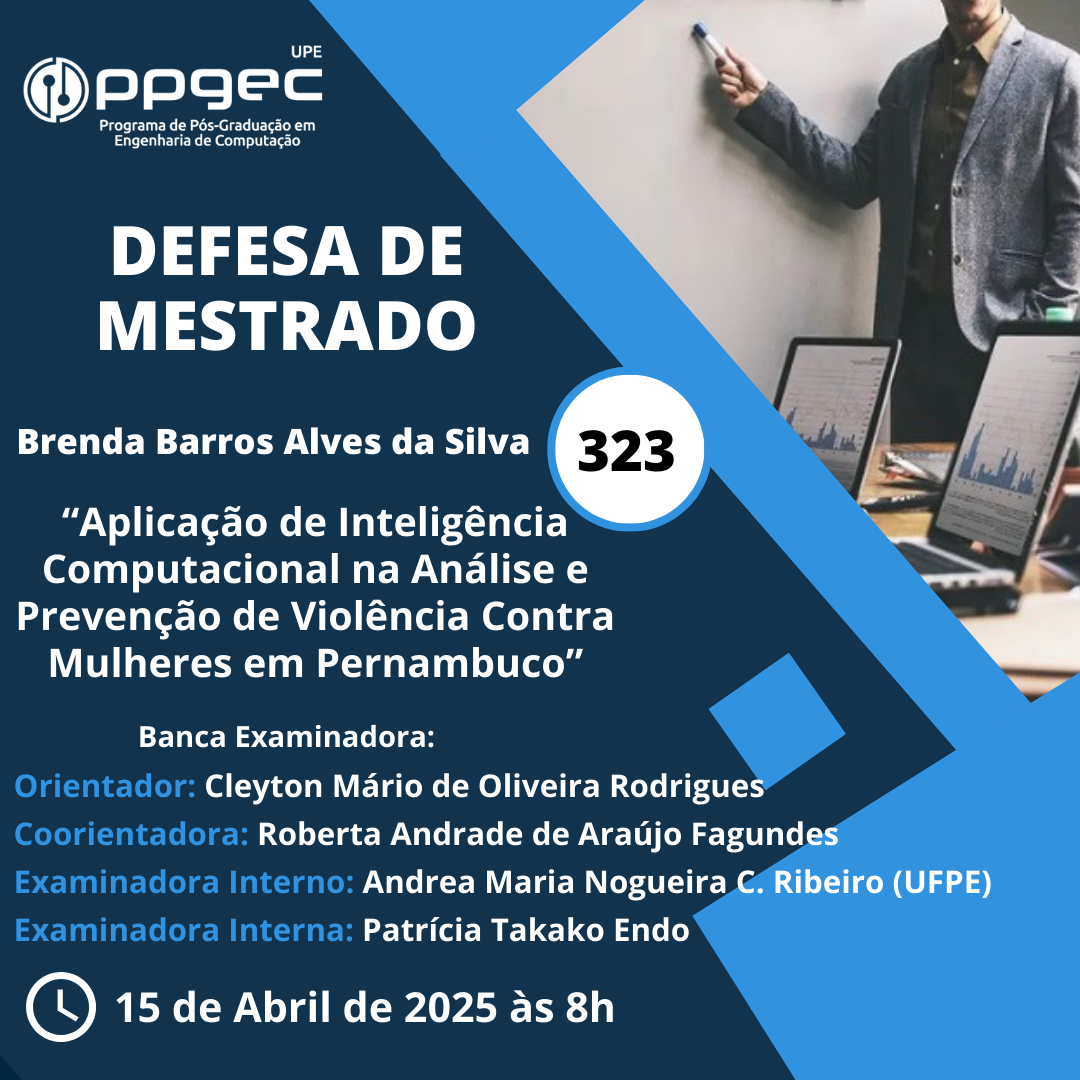
DEFESA DE DISSERTAÇÃO DE MESTRADO Nº 323
Aluna: Brenda Barros Alves da Silva
Título: "Aplicação de Inteligência Computacional na Análise e Prevenção de Violência Contra Mulheres em Pernambuco"
Orientador: Cleyton Mário de Oliveira Rodrigues
Coorientadora: Roberta Andrade de Araújo Fagundes
Examinadora Externa: Andrea Maria Nogueira Cavalcanti Ribeiro (UFPE)
Examinadora Interna: Patrícia Takako Endo
Data-hora: 15 de abril de 2025 às 8h
Local: Formato Presencial - Miniauditório (PPGEC)
Resumo:
" Este trabalho tem como objetivo investigar a aplicação de técnicas de aprendizado de máquina na análise e prevenção da violência contra a mulher. Fundamentado em uma abordagem interdisciplinar, o estudo explora conceitos relacionados à violência de gênero, visando compreender os padrões e tendências atuais desse fenômeno social. Para tanto, são empregadas técnicas computacionais específicas, incluindo Mapas Auto-Organizáveis (SOM), redes neurais recorrentes do tipo Long Short-Term Memory (LSTM) e o algoritmo Apriori para análise de associação. A metodologia adotada contempla o pré-processamento e análise exploratória detalhada de dados históricos sobre violência de gênero, uma revisão sistemática da literatura científica sobre o uso de aprendizado de máquina neste contexto, e experimentos com as técnicas mencionadas. Os resultados obtidos evidenciam a eficácia dessas abordagens na segmentação e identificação de padrões complexos, na detecção de associações significativas entre variáveis relevantes e na previsão de episódios futuros de violência. Por fim, são discutidas as implicações práticas dos resultados alcançados, ressaltando-se sua relevância para o desenvolvimento de políticas públicas eficazes, bem como apresentadas as contribuições do estudo, suas limitações e sugestões para futuras investigações na área. "
O Programa