

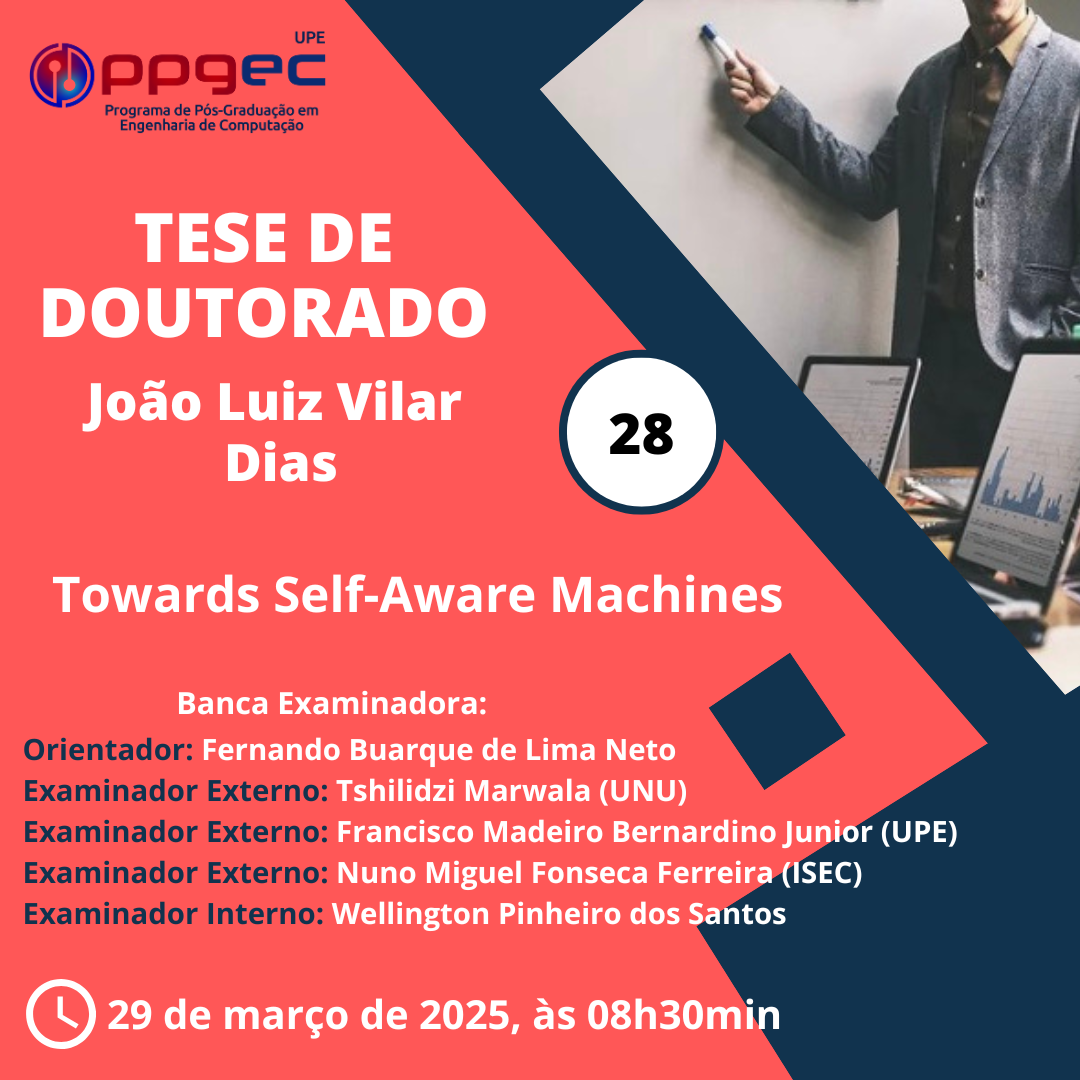
DEFESA DE TESE DE DOUTORADO Nº 28
Aluno: João Luiz Vilar Dias
Título: "Towards Self-Aware Machines"
Orientador: Fernando Buarque de Lima Neto
Examinador Externo: Tshilidzi Marwala (UNU)
Examinador Externo: Daniel Corrêa Mograbi (PUC-Rio)
Examinador Interno: Wellington Pinheiro dos Santos
Data-hora: 29 de março de 2025 às 8h30min
Local: Formato Remoto - Google Meet.
Resumo:
"The emergence of disruptive technologies and the principles of Industry 4.0, encompassing Control Systems, Artificial Intelligence, Data Science, and Intelligent Decision-Making have introduced a novel paradigm in assessing efficiency and quality objectives within production processes. Extensive discussions have revolved around enhancing machine productivity and refining decision-making through the use of intelligent decision agents, whether involving humans or purely algorithmic. The various tiers of decision-making—operational, managerial, and strategic—inevitably highlight the increasing necessity for seamless integration among such novel intelligent systems. To that matter, research on animal cognition suggests that more advanced species, beyond merely possessing reasoning capabilities to some extent, they also exhibit attributes categorized or related to self-awareness, which endow them with enhanced efficiency in decision-making and consequent actions. These sometimes-limited expressions of self-awareness allow them to perceive their position/role within an environment, both in isolation and in relation to other entities. Available opportunities and threats are important subjects tackled by such sentient and reasonable beings. By considering expressions of self-awareness on a smaller scale, e.g., intelligent industrial systems, one could likewise expect, greater efficiency. Such extended capabilities could also facilitate improved planning and operational decisions in complex scenarios, particularly in real-time contexts. This consideration raises the fundamental question of this thesis: how can intelligent computing systems be designed to incorporate self-awareness? This research explores the emergence of self-aware mechanisms in biological entities of varying cognitive complexity and their pragmatic approach for possible adoption in intelligent industrial systems. We assume that self-awareness is as a progressively adaptive response to environmental pressures, which organisms encounter when operating initially in isolation and later within intricate ecosystems. Even in its most rudimentary forms, self-awareness is employed by living organisms to guide decision-making, particularly through internal simulations that aid in navigating unpredictable circumstances. We argue that within an artificial framework, intelligent machines may derive significant benefits if using self-awareness attributes, mainly as these enable them to recognize their own needs, roles, contributions and interaction with others. From an evolutionary standpoint, self-awareness can be classified into three primary components: self-recognition (or bodily awareness), meta-cognition (the capacity to reflect on one’s own knowledge), and theory of mind (the ability to infer desires, beliefs, and knowledge in others). Despite its relevance, until now this perspective has not yet been comprehensively thought to be incorporated into intelligent computer system architectures. The present study aims to fully establish the concept of self-awareness in computational systems, with a focus on industrial machines. This thesis includes the proposition of a new classification hierarchy of levels (layers) for self-aware machines, introduces accompanying new Machine Learning methodologies based on Computational Semiotics to achieve profounder levels of self-awareness in machines, and provides simulations and argumentations to support these propositions, which ultimately aim (for now) at improved industrial performance. "
O Programa